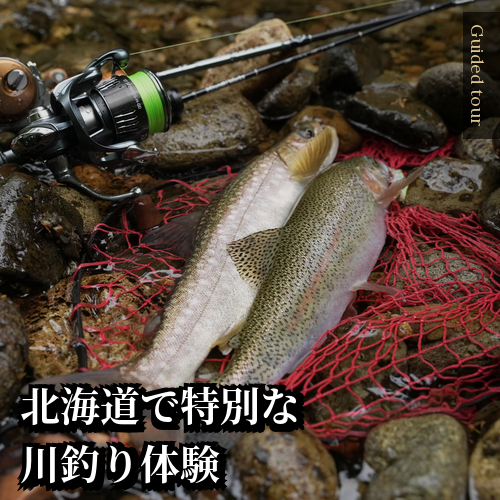

Learn to Read a River
Before You CastThe Slow Craft of Japan's Wild Trout Streams
One night at Hitotoki Base, one full day driven out to wild trout water most travelers never find. Hokkaido holds more native trout species, in greater size and number, than anywhere else in Japan — and here, they're caught on baitcasting tackle, not fly gear.
Japan's quiet obsession with doing one thing precisely.
The same discipline you'll find in a tea ceremony or a sword polisher's workshop lives on Hokkaido's rivers — in the cast, the retrieve, and the patience to wait for a single strike.
Read the water first
Before a single cast, you'll learn to see what the guide sees — current seams, holding pools, and where a native trout is likely resting.
Lures, not flies
Mountain trout streams usually mean fly fishing. In Japan, the tradition runs the other way — precise, delicate lures worked on baitcasting tackle. If you've fished bass or saltwater with a baitcaster, the gear will feel familiar; using it this way won't.
Precision Japanese tackle
You'll fish with hand-built Hokkaido rods, paired with purpose-tuned lures — the same setup used to chase native Amemasu trout in these exact rivers.
Release, always
Wild native trout are returned to the river. The goal is the moment, not the trophy.
Hokkaido is another world
More native trout species live here than anywhere else in Japan, and they run larger and more numerous than on the mainland. It's a different scale of fishing entirely.

"I didn't come to Japan to catch a fish. I came to understand why someone would spend twenty years learning to catch one properly."
— The feeling this day is built aroundHokkaido is Japan's trout sanctuary.
Mainland Japan has two native trout species. Hokkaido has seven — some found nowhere else on Earth.


Sakhalin Taimen (Ito)
A near-mythical trout exceeding a meter in length, ranked among Japan's three legendary giant fish.

White-Spotted Charr (Amemasu)
Thick-bodied and bold-spotted, this is the char most associated with the region's mountain streams.

Dolly Varden (Oshorokoma)
Found only in Hokkaido, nicknamed "the river's jewel" for coloring that photographs never quite capture.

Rainbow Trout (Nijimasu)
The powerhouse of Hokkaido trout fishing, often exceeding 60cm with a fight anglers come back for.
Iwana, Yamame, and Brown Trout also inhabit these rivers. See the full species guide →
Two guides on the water.
Nothing about your day is left to one pair of eyes.
 YOSHIKAWA & HAMAZAKI
Your river time is led by a two-guide team from Hitotoki Base: Yoshikawa and Hamazaki, working the same stretch of water together.
One guide stays close for casting coaching, while the other reads the water ahead, checks conditions, and manages safety — so you're never waiting, and never unsupervised near the river.
It also means the day adapts in real time: if one stretch is quiet, the team already knows where to move you next.
A hideaway in the Atsuma countryside.
Hitotoki Base's own guesthouse — tucked into the quiet countryside outside Atsuma, surrounded by forest and farmland. The rivers we actually fish are a short drive away, chosen for the fish in them, not for being nearby.
The guesthouse shares its roof with Hitotoki Works, the rod and lure workshop behind the tackle you'll fish with. Guests are welcome to browse the small shop on-site before or after the river.


From the airport to the river's edge.
You're collected the moment you land. Everything after that follows the rhythm of the river, not a bus schedule.
Arrival at Atsuma
Make your own way to Atsuma, about 30 minutes from New Chitose Airport — or ask us about pickup, arranged case by case depending on flight schedule and availability.
Transfer on requestCheck in at Hitotoki Base
Settle into your room at the base. This is home for the night — tomorrow, your guides drive you out to the actual water.
Evening briefing with Yoshikawa & Hamazaki
Over dinner, your two guides walk you through tomorrow's plan, check your gear fit, and answer questions — no rush, no schedule to keep.
Meet your tackle
To start the day, a hands-on walkthrough of the baitcasting reel and rod you'll use — how it differs from spinning tackle, and why it suits these clear, narrow streams.
Gear briefingCasting lesson, on dry land
Before wading in, you'll practice the cast itself — thumb control, release timing, and reading distance — with no pressure to perform.
1:1 instructionDrive to the river
Your guides drive you out to the actual fishing grounds — chosen for water quality and fish, not for being close to the guesthouse.
Morning session on the river
Your first casts at real water, coached pool by pool by both guides — one beside you, one reading the water ahead.
Riverside lunch
A simple riverside lunch of onigiri rice balls — a quiet break in the middle of the day, not a scheduled stop.
Afternoon session
With the fundamentals in hand, you'll fish a second stretch of river — applying what you learned, with lighter coaching and more independence.
Wrap-up & departure
Photos, a short debrief on what you learned, and onward travel — return transfer to New Chitose Airport can be arranged on request.
Transfer on requestWhy bait finesse, and why here.
Hokkaido's mountain streams are narrow, clear, and easily spooked — this style of tackle was refined specifically for water like this.

Baitcasting reel
Unlike the spinning reels most beginners know, a baitcasting reel sits on top of the rod and gives far more control over a short, precise cast — ideal for tight, tree-lined streams.
Finesse-weight rods
Short, light rods built to present a small lure delicately, so it lands and moves like something a wild trout would actually chase.
Purpose-tuned lures
Compact, silver-foil lures with a tight wobbling action, chosen specifically to imitate the small baitfish native trout feed on in these rivers.


Come from fly fishing? This will feel like a different sport — and that's the point. Come from bass or saltwater baitcasting? The gear is familiar, but using it this delicately, on water this small, isn't. Never held a rod at all? That's fine too — most first-time guests start from zero, and the morning's casting lesson is built to take you from nothing to fishing comfortably, no prior experience required.
A real casting lesson comes first.

This isn't a quick demonstration before being handed a rod. It's a structured, private lesson — because the goal of the day is for you to leave actually knowing how to fish this way, not just having watched someone else do it. Whether you've fished for years or never picked up a rod, the lesson starts from wherever you are.
- Grip, thumb control, and release timing for baitcasting reels
- Reading current seams and likely holding water
- Casting accuracy drills on land before entering the river
- Continuous coaching through both river sessions
- Guided with simple English words, gestures, and hands-on demonstration
What a morning on the water actually looks like.
A short clip from a recent trip on these same rivers.
Bring friends. The river has room for three.
Groups of two or three share the same guides, the same water, and a lower price per person.


Two guides. One river. One night at its edge.
A fully private overnight experience — lodging, tackle, instruction, and meals included, with airport transfer arranged on request. Priced per person, and it gets better with company.
Groups of up to 3 welcome — shared rooms bring the per-person cost down
| Group size | Per person | Total |
|---|---|---|
| 1 guest | ¥88,000 | ¥88,000 |
| 2 guests | ¥70,000 | ¥140,000 |
| 3 guests | ¥60,000 | ¥180,000 |
- One night's stay at Hitotoki Base
- Two guides, private group only
- Full baitcasting tackle rental
- Structured casting lesson
- Purpose-tuned Hokkaido lures
- Dinner & riverside lunch (onigiri)
- Fishing license & safety equipment
- Airport transfer — arranged on request
Limited to 3 guests per group to keep everyone close on the water. Suitable for complete beginners. Airport pickup/drop-off depends on flight schedule and guide availability — ask when booking.
The river is waiting.
So is your room at its edge.
Availability is limited to one private group per night.
Email Us to Book当店でご利用いただける電子決済のご案内
下記よりお選びいただけます。